Sunday, February 10, 2013

The Forms | Aristotle

"Aristotle, with his colossal common sense, was perhaps the greatest of all philosophers..." G.K. Chesterton


As I said, Aristotle took an opposite view from Plato's when it came to the idea of forms. Instead of concurring that what had started out as rational became empirical during the world's beginning, Aristotle believed that the answer to the forms lied within the physical itself.

(The fancy term for Aristotle's belief is "Hylomorphism" which means "matter-form.")

I'm actually having a little trouble finding some direct quotes (if you know them off of the top of your head feel free to comment below). But, I'm sure I'll come across them in my reading sometime in the future and update this post.

Otherwise, here's a summary found in Anthony Kenny's Ancient Philosophy:

"The difference between Aristotelian forms and Platonic Forms is that for Aristotle forms are not separate (chorista): any form is the form of some actual individual... Aristotle cannot avoid, however, the questions for which Plato sought a solution in his theory. He must, for instance, provide his own answer to someone who asks what is common to the many things that are called by the same name or fall under the same predicate. He must, that is, offer an account of universal terms...

Whatever there is must be either a substance or something that belongs to a substance, such as a quantity or a quality of it. When we are listing the things that there are, we may count, if you like, health and goodness; but any actual health is someone's health, and any actual goodness is the goodness of something or other. If we ask, in such cases, what really and truly is, the answer will be: this healthy person, this good dog... Material entities... are substances (p.217)..."

The gist of it is that Aristotle thought that what made a thing what it was (a cat is a cat because ______, a table is a table because ________, a horse is a horse because _______) is actually within the thing itself.

He focused on recognition. He saw that the true way to do this would be to interpret something within the object being observed itself. He was highly critical of Plato's idea of forms, preferring his own ontology.

In his philosophy, every physical thing of a certain type was that certain type because of their like-elements. A cat's a cat because it's furry, has pointed ears, whiskers, a cat-face, four legs, a tail, is a certain size, and meows (not because of some perfect cat form). A table's a table because it is made out of a sturdy substance and sits on inanimate legs (not because of some perfect table form). A horse is a horse because of its alike tributes that only horses have (not because of its form). Obviously, there are some overlap between the essence of things. But, that is where their true forms differ.

As you can see, his idea becomes more complex:

I don't believe this view is as important as Aristotle's view on the Causes. But, this idea has been highly influential especially within the medieval church and physics.

Saturday, February 9, 2013

The Forms | Plato

Before we get any further in The Everlasting Man, I thought it would be fair to address Plato's idea of forms which Chesterton has alluded to.

"Plato [insisted]... that ideas are realities; that ideas exist just as men exist." G.K. Chesterton


"The first thing about it one must investigate is the very thing set down at the beginning whenever one has to investigate anything: whether it always was, having no beginning of a coming to be, or whether it has come to be, having begun from some beginning.

It [the cosmos] has come to be; for it is visible and touchable and has body, and all such things are sensed; and things that are sensed... came to light as coming to be and begotten. And again, for what comes to be, we claim that it's necessary that it come to be by some cause...

One must go back again and investigate the following about the all [about everything that exists]: to which of the two models the builder looked when he fashioned it--to the one that's in a self-same condition and consistent, or to the one that has come to be. Now if this cosmos here is beautiful and its craftsman good, then it's plain that he was looking to the one that's everlasting, but if otherwise--which isn't even right for anyone to say--then to the one that has come to be. Now it's clear to everyone that it was to the everlasting; for the cosmos is the most beautiful of things born and its craftsman the best of causes. Now since that's how it has come to be, then it has been crafted with reference to that which is grasped by reason and prudence and is in a self-same condition...

There's every necessity that this cosmos here be the likeness of something... So then, when it comes to a likeness and its model, one must determine how the accounts are also akin to those very things of which the accounts are interpreters. Now accounts of what's abiding and unshakable and manifest with the aid of the intellect are themselves abiding and unchanging; and to the extent that it's possible and fitting for accounts to be irrefutable and invincible, they must not fall short of this.

But as for accounts of something made as a likeness of something else--since it is a likeness--it is fitting that they, in proportion to their objects, be likenesses: just as Being is to Becoming, so is truth to trust (Timaeus 28B-29C)...

Since this is so, it must be agreed that: one kind is the form, which is in a self-same condition--unbegotten and imperishable, neither receiving into itself anything else from anywhere else nor itself going anywhere into anything else, invisible and in all other ways unsensed--that which is intellection's lot to look upon (Timaeus 52A)..."

These forms are one of Plato's most popular ideas, implying that thoughts themselves exist on their own, in a more-perfect plane. I have summarized it this way before:

"What Plato tried to do in the Republic was to imagine what the form would be for the perfect society and the perfect order. This philosophy of Plato's forms is crucial to understanding a lot of his works. His idea is that there are, well, ideas that things like chairs, computers, dogs, rainbows, and people have in common. These ideas/forms are what defines a chair as a chair, a computer as a computer, a dog as a dog, a rainbow as a rainbow, or a person as a person. The form is not directly made so that every chair is identical. But, the same essence and function of a chair applies to every chair (that is how you recognize what a chair is instead of confusing it with a different form such as an elephant's)..."

Here, in Timaeus, we can understand that Plato's theory of cosmological genesis happened temporally. The creator/poet/father took the perfect essences/ideas/forms which he knew and created something [literally] sensational from them. But, somehow in becoming sensational, the forms lost their purity, becoming imperfect and temporal instead of eternal.

In this way, what is rational becomes empirical. Aristotle, Plato's pupil, came to the opposite view.

Still, Plato believes that the forms exist, they are the things that our reason uses to tell objects apart. And, fittingly, there are objects that can only be in the formal world as well as objects that can only be in the sensational realm:


Many have used the Cave as an example of seeing the world unenlightened by the Good and other forms.

Here's Aristotle's view.

And, more of the Timaeus:

<-1-2->

Thursday, February 7, 2013

The Everlasting Man | The Philosophers


"The fourth and final division of the spiritual elements... [in] heathen humanity... The Philosophers (p.81)...


What are here called philosophies are very often called religions. I believe however that my own description will be found to be much the more realistic and not the less respectful. But we must first take philosophy in its purest and clearest form that we may trace its normal outline...

Polytheism, or that aspect of paganism, was never to the pagan what Catholicism is to the Catholic. It was never a view of the universe satisfying all sides of life; a complete and complex truth with something to say about everything. It was only a satisfaction of one side of the soul of man, even if we call it the religious side; and I think it is truer to call it the imaginative side. But this it did satisfy; in the end it satisfied it to satiety. All that world was a tissue of interwoven tales and cults, and there ran in and out of it, as we have already seen, that black thread among its more blameless colours; the darker paganism that was really diabolism. But we all know that this did not mean that all pagan men thought of nothing but pagan gods.

Precisely because mythology only satisfied one mood, they turned in other moods to something totally different. But it is very important to realise that it was totally different. It was too different to be inconsistent. It was so alien that it did not clash.

While a mob of people were pouring on a public holiday to [idolatrous festivals]... this or that man would prefer to stop at home and think out a little theory about the nature of things. Sometimes his hobby would even take the form of thinking about the nature of God; or even in that sense about the nature of the gods. But he very seldom thought of pitting his nature of the gods against the gods of nature...

The first student of abstractions. He was not so much antagonistic as absent-minded. His hobby might be the universe; but at first the hobby was as private... even when his wisdom came to be a public possession, and almost a political situation, it was very seldom on the same plane as the popular and religious institutions (p.81).

Aristotle, with his colossal common sense, was perhaps the greatest of all philosophers; certainly the most practical of all philosophies But Aristotle would no more have set up the Absolute side by side with the Apollo of Delphi, as a similar or rival religion, than [some other ridiculous, but dated, example]... Or we might as well imagine Euclid building an altar to an isosceles triangle, or offering sacrifices to the square of the hypotenuse. The one man meditated on metaphysics as the other man did on mathematics; for the love of truth or for curiosity or for the fun of the thing.

But that sort of fun never seems to have interfered very much with the other sort of fun; the fun of dancing or singing to celebrate some rascally romance about Zeus becoming a bull or a swan. It is perhaps the proof of a certain superficiality and even insincerity about the popular polytheism, that men could be philosophers and even sceptics without disturbing it. These thinkers could move the foundations of the world without altering even the outline of that coloured cloud that hung above it in the air.

For the thinkers did move the foundations of the world, even when a curious compromise seemed to prevent them from moving the foundations of the city. The two great philosophers of antiquity do indeed appear to us as defenders of sane and even of sacred ideas; their maxims often read like the answers to sceptical questions too completely answered to be always recorded. Aristotle annihilated a hundred anarchists and nature-worshipping cranks by the fundamental statement that man is a political animal. Plato in some sense anticipated the Catholic realism, as attacked by the heretical nominalism, by insisting on the equally fundamental fact that ideas are realities...

Plato [did stuff]... Aristotle... considered the nature of men as well as the nature of morals, and looked to the eyes as well as to the light. But though these great men were in that sense constructive and conservative, they belonged to a world where thought was free to the point of being fanciful. Many other great intellects did indeed follow them, some exalting an abstract vision of virtue, others following more rationalistically the necessity of the human pursuit of happiness [eudaimon]. The former had the name of Stoics; and their name has passed into a proverb for what is indeed one of the main moral ideals of mankind: that of strengthening the mind itself until it is 
of a texture to resist calamity or even pain. But it is admitted that a great number of the philosophers degenerated into what we still call sophists [those who argue to win instead of to learn]. They became a sort of professional sceptics who went about asking uncomfortable questions, and were handsomely paid for making themselves a nuisance to 
normal people.

It was perhaps an accidental resemblance to such questioning quacks that was responsible for the unpopularity of the great Socrates; whose death might seem to contradict the suggestion of the permanent truce between the philosophers and the gods... The general compromise remained, whether it was that the Greeks thought their myths a joke or that they thought their theories a joke... there was never any combination in which one was really reconciled with the other. They certainly did not work together; if anything the philosopher was a rival of the priest. But both seemed to have accepted a sort of separation of functions and remained parts of the same social system (p.82-83)..."


Emerging Christian Philosophy | William Lane Craig


Here's another interview with William Lane Craig.

The beginning of this video actually discusses some of the issues that I mentioned yesterday in the Deadpool devotion.

Here's more on Anthony Flew's faith-life and a little something on the Evangelical Philosophical Society.

=====================================

Otherwise, check out:

<-Philosophy--Christian Critical Thinking-Advice to Christian Philosophers->

William Lane Craig posts:


<-Belief to Faith Q&A-Recent Debate-Phil. Foundations Book->


Other neat stuff:

<-The Everlasting Man-Religion's Place in Society Debate-Mmm... Bacon->


Wednesday, February 6, 2013

Insane Deadpool


We've already had a week about the dichotomy of Deadpool, sharing his origin story.

Have we really?

Umm... Yeah. It's right here.

Sure... How do I know you're not just playing me?

How do I know that this isn't just some sort of way for me to accidently download
a virus that constantly spams my computer with pictures of nude chimichangas?

Uh... I guess I don't really... Just click the link.

Fine.

Fine.

Fine.

You know, now that you mention it...
I could really go for some Mexican food.

CHIMICHANGAS FOR EVERYONE!!!!!!!!!!!!!


Anyway...

There's more to say about the Merc with a Mouth.

Of course there is.

Shut up.

Make me.

YOU KNOW I CAN!!!

Do it. Do it.

Just takes one little finger to pull the trigger...

Like you haven't done that before...

Guys... Guys... Come on now, 
they're probably getting sick of this.

Before the Deadpool reboot for MARVEL NOW!, Mr. Wade Mercenary-Amazingness Wilson had more thoughts swimming around in his head than accidents in the kiddy pool. Long-time fans of his may or may not have noticed the emptiness and lack of thought the character has now. But, back in the day--

--Get on with it!!

Shhh... I'm trying to pay attention...

I guess, we don't really need to reflect on the past too much to get where we're headed. Now, if your brain isn't already fried enough, there is a comic-book series continuing DP's thought-filled-legacy:


Get it? Get it?

Duh, it's like "Illustrated"
But, with a "K..."
Making it Killustrated.

After the astounding and horrific even that was "Deadpool Kills the Marvel Universe," DP is on a quest to not only finish what he has started, wiping the whole fictional realm out of existence, but to destroy the entire multiverse... 

And, guess who he blames...

Us?

Yeah... Us!!

Whelp... What can yah do?

Some haywire scheme by Psycho Man leaves Deadpool's mind in even worse shape than it was before... That's saying something... Instead of hearty and comical characters, DP's voices become voices of (even more) irrationality and universal-homicide piners... or, even pioneers, I guess...

To begin the rest of his journey to destroy everything, DP heads back to the stories that have inspired the modern tales. He slaughters Moby Dick, haunts Uncle Scrooge, and hunts down Sherlock Holmes.


WHO CARES?!?!?
They're all just puppets anyway...
They're only playing the parts of the roles that they were written for.
A simple death would be better than that.

Yeah!! Why you gotta take it all out on us?!?
And, yes, we do know that all of these characters are
Well, characters...

We can break the fourth wall.
Remember?

Gah!! That'd be creepy if Deadpool...
I mean 'I' broke the fourth wall
in a MOVIE!!!

Man, with all of these voices, I almost forgot where I was going with this... I really don't see how Deadpool does it. I guess I can see why they left them out of the new series.

That's just how the world is though, isn't it? Insane.

It's true. We have these voices coming out of everywhere. We have so many philosophical idols that shout out to us that we have trouble remembering our own thoughts. People say, "You must believe this!!" "You must believe that!!!" "You're wrong!!!" "No, you're wrong!!!"

See what he's doing there?

Yeah... he tried to get rid of us.
But, then he just started making his own voices...

What a noob...

In a world like this how are we supposed to keep everything straight?? We know that it's dangerous to listen to the wrong voices. We might turn out as dangerous as Deadpool if we do. But, how can we keep them outside of our heads??

It's tough. And, sadly, the voices usually don't offer you a way out. They are anything but helpful.  They lie.


Once you start to listen to them, they tell you how much of a joke everything is. They start sharing with you that you don't really need anyone else. You don't need to be dependent. You don't need the world or anyone in it. In fact, everything you have believed up until now, everything you've ever felt, everything that you have ever witnesses... it has all been a lie... a purposeless illusion. Now, don't ask those voices "Why?" They admit that they have no answer for you. "It's just the way it is." What they do claim to know is that you can just throw it all out. "You don't need what you don't understand." Another lie. They tell you that you can just kill off all of those fairy-tales like philosophy, history, and religion. "They're meaningless." They say that there's nothing wrong with obliterating whole realms of non-provable thought. "They're just someone's ideas." "They are nothing when compared to science!!!" More lies.

Now, I admit. I am just another one of those voices. But, I'm not claiming that you need to listen to me. I'm hoping to show you a better, stronger, solid place to look for your answers instead of just having lies spoon-fed to you.

Before the other lies convince you to stop believing in anything... to only see the world as chemicals and reactions... causes... effects... limited to what you can empirically see...  the opposite of rationality... before they insist that you cannot rely on only your five senses... leaving your mind behind... teaching you to worship Science... and ignore Philosophy... I beg of you, heed this voice, my sole voice, calling out to you in this modern wilderness... 

There is ONE firm foundation. Jesus Christ, the Lord, the Logos, the meaning, made flesh. Emmanuel  God with us. To know him, prayerfully study His word.

We have a grounds to stand on. "A stone, a tested stone, a precious cornerstone, of a sure foundation." Is. 28:16. "The stone that the builders rejected has become the cornerstone" Matt. 21:42. Do not build your house on quicksand. But, on stone.

"The fear of the Lord is the beginning of wisdom." Proverbs 9:10.

We are more than characters or puppets, we are beloved children of God, Secured through Christ's sacrifice.

Otherwise, there is no meaning. The voices tear you down, one belief after another. They kill your foundations. They kill your understanding of not only the world, but also of who you are. They take your purpose and declare it a farce. And, ironically, they leave themselves no worldview to stand in.

Think about it.

After these voices destroy the world around them...

What will be left for them to stand on?

Nothing?

Nothing.

...

You know what I'm still waiting for?

Chimichangas?

CHIMICHANGAS!!!!!!!


Condemning Faces


The Meyer Minutes from the other day reminded me of a scene from one of my favorite books, Special Deliverance (p.68-70):

Mary, Lansing, and Jurgens have made camp for the night:

"Lansing woke suddenly from a sound sleep. He fought his way to a sitting position, pressing against a force that tried to hold him down.

In the flicker of the firelight, he saw Jurgens standing over him. The robot's hand was gripping his shoulder and he was making shushing sounds.

'What's the matter?'

'It's Miss Mary, sir. There is something wrong with her. Like a fit.'

Lansing turned his head to look. Mary sat upright in her sleeping bag. Her head was tilted back so that she looked toward the sky.

He... stumbled to his feet.

'I spoke to her,' said Jurgens, 'and she didn't hear me. I spoke several times, asking what's the matter, what could I do for her.'

Lansing strode over to her. She seemed carved in stone--stiff and straight, held in an invisible vise.

He stooped over her, cupping her face in his hands, pressing gently.

'Mary,' he said. 'Mary, what is wrong?'

She paid him no attention.

He slapped her with one hand, then slapped her with the other. The muscles of her face relaxed and shivered. She collapsed, reaching out for him--not for him, he knew, but for anyone.

He seized her and cradled her close against him. She was shaking uncontrollably and began to sob, soft, subdued sobbing...

'Where am I?' she whispered...

'I woke up and they were bending over me, looking down at me...'

For a time she said no more... a softening of tension... had gripped her...

'That was frightening... I've never been so scared...'

'What was it... a bad dream?'

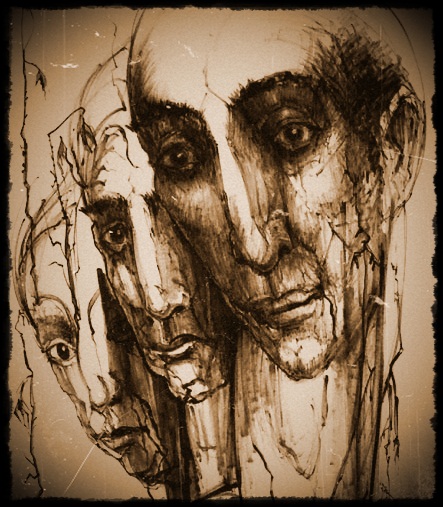
'More than a dream. They were really there, hanging in the sky, bending from the sky... I woke up,' she said. 'A nice, easy waking up. Not jerked out of sleep. I was lying on my back so that when I woke, I was looking straight up at the sky... They were three... the three of them--or I think there were three of them. There could have been four. Three faces. No other parts of their body. Just faces. Big faces. Bigger than human faces, although I am sure they were human. They looked human. Three big faces in the sky, filling half the sky, looking down at me. And I thought how silly to think that I am seeing faces. I blinked my eyes, thinking it was my imagination and they would go away. But they didn't go away. After I had blinked I could see them even better...'

'Dammit... You're thinking hallucination aren't you?'

...

'There was nothing wrong with the faces. Nothing outrageous. Quite ordinary, now that I think of it. One of them had a beard. He was the young one, the other two were old. Nothing wrong with them, I said--not to start with. Then it began to seep into me. They were looking intently at me. Interested. The way one of us would be interested if we came across an odious insect, an abominable creature of some sort, a new sort of life. As if I weren't a creature; as if I were a thing. There was, to start, what I thought might be a look odd compassion for me, then I saw it wasn't--it was, rather, a mingled contempt and pity and it was the pity that hurt the most. I could almost read their thoughts. My God, they were thinking, will you look at that! And then--and then...'

'And then they turned their heads away. They didn't go away. They only turned their heads away, dismissing me. As if I were beneath their notice, beneath contempt, unworthy of their pity. As if I were nothing--and, by extension, the human race was nothing. Condemning all of us to nothingness, although condemn may be too strong a word. We were not even worth their condemnation. We were a lowly form of which they would think no further."

Intense, right?

And, sadly most people have probably given in to this idea with God. Even if they were to believe that a god existed, they would fall into the trap of Aristotle and insist that god would be too great to care about us.

There's something inside each of us that knows that we aren't even worthy of God's notice, contempt, or pity. We don't even deserve His consideration let alone His attention. Like a higher-than-life role model, we cannot understand why He would willingly heed us at all.

With this consideration, it would be easy to give up on God. We would give in to the secular philosophies that the world is meaningless, worthless, and hopeless. Nihilism is the only other option.

But, to say we are unworthy of God is to say that He is unworthy of us.

The moment we give in to the secular philosophy, we turn the tables around. We would begin (and have begun) "looking intently. Interested. The way one of us would  be interested if we came across an odious insect, an abominable creature of some sort, a new sort of life."

As if God weren't a living-being creature, we then degrade him to "a thing."

And, then we do exactly what God has never done to us. Like an "adulterous wife, who receives strangers instead of her husband," we turn our face away from God for our own solicitations.

We don't leave His presence. He remains present. We are the ones who stay and turn our heads away, dismissing Him. As if He were beneath our notice, beneath contempt, unworthy of pity.

As if He is nothing. As if He doesn't exist at all.

Many people condemn the very idea of God. But, even more-so, they act as if He isn't even worth their condemning. As if He is the lowlier form and we are somehow greater. And, to tell the truth, we are greater. But, only in arrogance.

God is unchanging. His look that we saw, the glimpse of odd compassion, it remains. It doesn't turn to contempt or to pity, although we wish it did. We know we are worthy of something much worse than condemnation. Our ever-doubting, ever-questioning, and ever-whoring with false ideas deserves something worse than an eternal fire.

But, God's compassion is a very odd compassion indeed. It is the sort of compassion that we can only begin to see in an artist's compassion for their creation; a father's compassion for his child; and a husband's compassion for his bride.

Although we wander astray, to false idols of philosophical doctrine, God remains. "I have loved you with an everlasting love; therefore I have continued my faithfulness to you." Jeremiah 31:3.

This compassion, this loving faithfulness and faithful love, has been made complete in the person of Jesus Christ. "Let it be so now, for thus it is fitting for us to fulfill all righteousness [to complete all that is good in the eyes of God]." Christ's first recorded words in the Bible, Matthew 3:15.

The bridegroom remains faithful to His bride.

Tuesday, February 5, 2013

The Importance of Philosophy | William Lane Craig


Here's a great insight on Colossians 2:8 and the importance of being aware of and being wary of philosophy with Dr. Craig. Although, these two gentlemen discuss the only verse in Scripture which discusses "philosophy," there are many other verses encouraging "the love of wisdom" and thinking.

Here are just a few:

Prov. 8:1 and 9:9-10 "Does not wisdom call? Does not understanding raise her voice?" "Give instruction to a wise man, and he will be still wiser... The fear of the LORD is the beginning of wisdom." (1 Kings 3 is also great.)

1 Cor. 14:20 "Brothers, do not be children in your thinking. Be infants in evil, but in your thinking be mature."

Many times through-out the Gospels, Jesus wishes that his disciples were able to think through and understand his parables on their own. "And he said to them, 'Do you not yet understand?'" Mark 8:21. He almost assumes that his followers would be able to be faithful and thinking men. "'If the blind lead the blind, both will fall into a pit.' But Peter said to him, 'Explain the parable to us.' And he said, 'Are you also still without understanding?'" Matt. 15:14-15. "With many such parables he spoke the word to them, as they were able to hear it. He did not speak to them without a parable, but privately to his own disciples he explained everything." Mark 4:34.

This is so prevalent that an article by Peter Scaer, which I have recently referenced, describes Jesus along with the early Christians as philosophers.

I haven't even mentioned the Christian Apologetics creed: 1 Peter 3:15.

=====================================

Here's more on Christian thinking and philosophy:

<-Christian Critical Thinking-Advice to Christian Philosophers->

For more William Lane Craig, check out these posts:

<-Belief to Faith Q&A-Recent Debate-Phil. Foundations Book->

Other neat stuff:

<-The Everlasting Man-Religion's Place in Society Debate-Mmm... Bacon->