Thursday, March 19, 2015

Pirates Vs. The World


The Pirate Party is now measured as the second biggest party in Iceland


Rejecting corruption and hubris
"To be completely honest: I don’t know why we enjoy so much trust, we are all just as surprised, thankful and take this as a sign of mistrust towards conventional politics,” says Birgitta Jonsdottir, the captain of the Pirate Party. In addition, she refers to surveys having shown that the people’s trust in politicians is below zero.

“Traditional politics have not shown progress and people are tired of waiting for change. It is good that people are rejecting corruption and hubris...

“We take this with humility. This must be a clear message to the government, especially to The Independence Party (Sjálfstæðisflokkurinn) and their arbitrary governance.”
„I didn´t really expect this to happen within a decade of the first party founding. That's kind of cool. No actually, it's bloody awesome,“ says Rick Falkvinge, the political evangelist for the global pirate movement, in a comment on Reddit about the news of the Pirate Party in Iceland.
http://www.visir.is/the-pirate-party-is-now-measured-as-the-biggest-party-in-iceland/article/2015150318848


Wednesday, March 18, 2015

Worlds Collide | Lent 2015


Notes:

Fourth Sunday – Lent 2015
Numbers 21:4-9

22:22-29 Israelites in the wilderness directly after the death of Aaron… Moses is still leading them.

21:1-3 Canaanites captured some Israelites and the Lord let Israel destroy the Canaanite cities in retribution.

Txt: They were headed around the Edom (the way of the Red Sea)… They became impatient. They spoke against God and Moses, “Why have you brought us up out of Egypt to die in the wilderness? For there is no food and no water, and we loathe this worthless food.” 

The Lord sent fiery (poisonous) serpents among them… They were bitten… many died…

The people came to Moses and said, “We have sinned… we have spoken against the Lord and against you. Pray that he may take the serpents away from us.” Moses prayed for the people.

The Lord said, “Make a fiery serpent and set it on a pole… everyone who is bitten, when he sees it, shall live.” Moses made this bronze serpent and set it on a pole. If a serpent bit anyone, he would look at the bronze serpent and live…

Later: They continued toward the Promised Land


Ephesians 2:1-10[1]

Prior: Greeting, thanksgiving/prayer… the Lord reigns theme

Txt: You were dead in trespasses and sins in which you walked[2] … following the world (instead of the Way)… the prince of the power of the air[3]… the spirit at work in the sons of disobedience…[4] --among whom we have all once lived in the passions of our flesh… desires of the body and mind… children of wrath, like the rest of mankind. God, due to his rich mercy, His great love… even though we were dead, we have been made alive together with Christ by grace you have been saved…. Raised up with him and seated with him in the heavenly places… in the coming ages he might show the immeasurable riches of his grace and kindness toward us in Christ… by grace you have been saved through faith. And this is not your own doing; it is the gift of God… not a result of works so that a man may boast. But, we are his works… his workmanship, created in Christ Jesus for good works which God prepared beforehand, that we should walk in them.

Continues: We are One in Christ… circumcised of heart… reconciled

John 3:14-21

Prior: Behold, the Lamb of God… Wedding at Cana… Jesus cleanses the Temple… Jesus knows what is in man. Jesus… did not entrust himself to those at a Passover feast in Jerusalem because he knew all people and needed no one to bear witness about man, for he himself knew what was in man…

Chapt. 3: You must be born again. Nicodemus conundrum how can you do these signs?!?… born again… answers with a riddle. How can an old man be born again?!? A: born of water and the Spirit… flesh leads to flesh, but spirit leads to spirit… do not marvel, the wind blows where it wishes, you hear its sound, but you don’t know where it’s coming or going… it’s the same with those who are born of the Spirit. How can these things be?!? You’re a teacher of Israel, yet you do not understand?? We speak of what we know and bear witness to what we have seen… But, you do not receive our testimony… if I tell you earthly things and you do not believe, how can you believe when I tell you heavenly things?? No one can ascend except the one who has descended…

As Moses lifted up the serpent in the wilderness, so must the Son of Man be lifted up, that whoever believes in him may have eternal life.

God so loved the world, that he gave his only Son, that whoever believes in him should not perish but have eternal life… he did not send his son to condemn the world, but in order that the world might be saved through him… whoever believes in him is not condemned, but whoever does not believe is condemned already, because he has not believed in the name of the only Son of God….

Light has come into the world.. people love darkness because their deeds were evil… the light exposes our evil deeds… whoever does what is true comes to the light so that it may be clearly seen.

Continued: John the Baptist… precursor to Christ… He who comes from above is above all. He who is of the earth belongs to the earth and speaks in an earthly way. He who comes from heaven is above all. 3:31


Emphasis/Ideas
World vs. heavenly contrast
Ephesian: Heraclitus
Focus on Nicodemus… earth vs. heaven… evil vs. uplifted/sanctified
Gospel seems to contradict Ephesians’ focus that God has prepared our deeds and light focus on revealing our deeds… explain/expound how this doesn’t contradict…
Vikings: the thing about power is that one must be willing to bend down to pick it up.


Worlds Collide
That the Hearers work in this world, but not of this world... (Epistle)

Grace mercy and peace to you from God the Father and Jesus Christ, His Son, Our Lord. Amen.

All these words, hear them with your ears. But, hold them in your heart. (Ez. 3:10)


Wow. It is my joy to be here today. And, what a journey it has been since I have last seen you. My family has moved up to Wisconsin, my sister is about to graduate from college in Minnesota, my brother is attending Valparaiso University, and I’ve graduated from Concordia Wisconsin. Now, I continue my studies at the Concordia Seminary in St. Louis as well as keep busy at work at the international center of the LCMS. There, I make phone calls, raising funds for different ministries including the seminaries, disaster relief, and missionaries all around the world.

The Epistle lesson for today is from a letter Paul wrote to the Ephesians. It reminded me that one of my co-workers at the International Center actually had the privilege of visiting Ephesus. She said it was beautiful. Many of the ancient structures still stand. She saw pillars and other signs of antiquity. She had earned her trip by helping with the missions of our synod and said she was glad to enjoy it. But, even today as she traveled the ancient city, there were signs of an ancient lifestyle. One of these signs were the particular markings on the streets both for Christian safe-houses and prostitution rings. There were circles with lines in the middle of them pointing to the closest safe place to worship. But, on the ground, there was a footprint with signs marking the closest brothel. Both faith and sin abounded, but sin seemed to be the emphasis. In fact, they had once had underground tunnels leading from the library where men would leave their wives for the day in order to study to the closest place of promiscuity.

With the remnants of this culture, thick with immorality, there is a story of a man who had once lived there. As you may recall, part of my bachelor’s degree at Concordia was in philosophy where I studied the western thinkers before the birth of Christ. These were men such as Aristotle, Plato, and Socrates. They were the first to bring a place for deep thought to the west. Perhaps, most ironically was the fact that even they were influenced first by the minds of the East, such as a man who lived in Ephesus named Heraclitus.

Heraclitus is also known as “the Wheeping Philosopher.” This is because he stood alone and wept for his city, Ephesus, and its immorality. He saw himself as the only virtuous person in Ephesus and could not comprehend why they wanted to kick him out of town. They wanted to exile him. Perhaps it was because of his religion. One of his biggest laments was against the Ephesians’ idea of God. Before Paul sent this letter of Good News to the Ephesians, even more of them believed in Zeus, Hercules, and the gods of Olympus as well as other idols made of stone. Heraclitus knew this couldn’t be true.

The religious folk accused Heraclitus of impiety and he wept saying that there was no way to be pious if they never taught who god truly was. He lamented at the fact that his peers did not even know where god was. He asked them, “Do you think he’s shut up in temples?” “You are a fine sort of pious men, who set up God in darkness! … Don’t you know that God is not wrought by hands, and has not from the beginning had a pedestal, and does not have a single enclosure?”

Instead of concerning themselves with theology, Heraclitus’ peers behaved as animals. Actually, Heraclitus thought the animals were better than his peers. He cries that animals know better than to pick up swords to fight one another. Even the animals who have adjusted to live with men have become tame and domesticated. But, the men who live amongst men remain wild. He pondered “how wicked will men get?” How long will they let vice pile up on vice and ignore any sort of virtue? How long will they be slaves to their passions? He understood that “vice alone enslaves and virtue alone liberates.” But, his fellow Ephesians had no virtue to liberate them.

All of these thoughts so far were contained in Heraclitus’ letters. They have been saved through-out time and translated from Ancient Greek to English. There are only seven or eight of them in total. And, all of Heraclitus’ other philosophical work has only been saved in fragments. He has many bits and pieces of tiny advice, but it is hard to grasp a deep understanding from just a sentence or two. They really remind me of Facebook statuses.

As I travel a lot and move one place to the other, Facebook has become the easiest and quickest way to stay in touch with so many people that I know and care about. It would almost seem impossible to text, call, send out postcards, or even email as many people as I can contact with a single click on Facebook. And, I am both surprised and glad that so many of you have opened up your own Facebook accounts. It’s a great way to stay in touch with family and see pictures. And, it is really great to have a random “like” or comment from one or two of you.

But, Facebook as well as other media such as the news, is also a constant reminder that our world really hasn’t changed all that much. It is easy for us to go online or sit down in front of the T.V. and spend hours hearing about what’s wrong in the world. Some things are important and warn us of dangers we may need to protect ourselves from. But, others just seem to be people complaining about everything, even about other people complaining. There are pictures of kids drinking, evidence of promiscuity, harsh debates, and slander. In this whole mess of live-streamed negativity as well as confessions of immorality, it is easy to feel just like Heraclitus… the only moral person left.

But, Paul, inspired by the Holy Spirit, begins the second chapter of Ephesians reminding us that we were all just like the sinners that we see around us. We were dead in our trespasses. We were dead in our sin. We lived in error and in bad judgment. We became the slaves to our vices. The influence of the world tossed us about.

One of the commentators on this text said that Paul was actually being gentle here. He realized that we are sinful, we deserve the blame, but Paul also writes about an accomplice.[1] The prince of the power of the air distracts us. He leads us astray, Satan himself, commands this domain beneath heaven, but above the earth… the air. Here, he twists words and creates miscommunication. He whispers lies and shouts secrets. He encourages vice and slanders virtue.

We, like the rest of the world, are helpless against his attacks. We continue to sin. We continue to trespass against one another. You would think that since we know God, things would get better. But, that’s not always the case. We’re not immune to the attacks of the prince of this world.

There is evidence of this in the Old Testament lesson. As the Israelites continued their march to the Promised Land, after witnessing so many miracles and wonders of a caring and loving God, they once again grew impatient. This is a consistent theme in their story, they work hard, they trust in God, they trust in Moses, but then they get discouraged. They lose faith. And, it isn’t very long before they blaspheme their own Lord or create something else to worship such as a golden calf or their own stomachs.

In this example, they’re tired and thirsty. They’re sick of the food that God has already miraculously supplied for them. They wish they had died in Egypt rather than live through this torture. Just when they thought things were getting bad, things got worse. Doesn’t this seem to happen to us a lot? We often struggle to find the point in our suffering. We have aches and pains and things we just can’t get off of our mind. But, then something worse happens. Our perspective shifts. We begin to wish that our problems were as easy as before. Many times when these problems hit, we turn not to God, but to our vices. We complain. We slander. We become slaves to our sin. We become just as dead in our trespasses as the bitten Israelites had become. We die because anything apart from God is dead. Yet, the Gospel calls us to look up.

Even when we were dead in our trespasses, God, being rich in mercy, because of the great love with which he loved us, made us alive together with Christ!! By His grace we have been saved. Even for the Israelites, God was merciful. He healed those who looked up in hope above their own problems and above their own sin. Above the influence of this world, a bronze serpent on a pole was hung. And, everyone who looked at it lived.

Now, we know that Jesus Christ has brought the same salvation to us. He took the case in the Old Testament and amplified it to not only save Israel, but the world. He prophesied that he would be lifted up just as the serpent had been lifted up… nailed to a cross. And, whoever believes in the Good News, the saving grace of God and redemption through the death of Christ, will live… not just now, but forever… eternally.

I heard in a recent television show, one riddled with just as much sin and immorality as any other a remarkable quote: “To achieve great power, one must be willing to stoop down to pick it up.” That is what Jesus Christ has done for us. He sees us dead. We’re lying on the ground wailing, just as good as dead, wishing we had died a long time ago, just like the Israelites, instead of suffering through our trials. We sin by complaining against God and against the leaders he has given us. We trespass against each other. We give into our vices… create idols out of abstractions… And, Jesus stooped down to us, to pick us up. This wasn’t to earn his own power. He didn’t need that. He is Lord. He is God. He is power. But, he stooped down to pick us up to join in his riches and grace.

He raised us up with him on that third day when he rose from the tomb so that we may be seated with him in heaven. Forever. This is all about what he has done, not about what we can do. If this saving grace was up to us, we’d boast. We’d get big-headed and prideful. And, in that act, we would fail ourselves. We would give into our vices once again. Instead, we are humbled.

At the beginning of the message, I talked about myself a lot. Part of it was because I thought I should update you. Part of it was because I have been able to do so many great things and witness so much. I haven’t even mentioned ministering in the national parks yet. But, the entirety of it was because of Jesus Christ. I am just his workmanship… created for His good works, established not in the musings of this world, the influence of sin and Satan, but established in His Word, the Gospel, His power.

And, so are you… created by God to perform the works he has prepared in advance for you to do. Christ is the one who stands alone as righteous, calling out to us to make us righteous… To take the credit for ourselves is too much. He is the one who stooped down to us. And, he is the one who picks us back up to be with Him. Amen.

Now, may the peace that passes our human understanding guard your hearts and minds in Christ Jesus as he works through you from now into eternity. Amen.


[1] Chrysostom understands that Paul is being gentle with the Ephesians, giving them an accomplice… "Why does he call the Devil 'the prince' of the world? Because nearly the whole human race has surrendered itself to him and all are willingly and of deliberate choice his slaves. And to Christ, though He promises unnumbered blessings, not any one so much as gives any heed; whilst to the Devil, though promising nothing of the sort, but sending them on to hell, all yield themselves. His kingdom then is in this world, and he has, with few exceptions, more subjects and more obedient subjects than God..." (Chrysostom n.d., Loc 2524)

[1] “The universe is rifted. History and the heart of man are rifted. The fact of a rift is the elemental, decisive fact about reality and its wholeness. In the background… the vast scheme of reconciliation.” “There exists a condition of total spiritual disorder. This disorder not only characterizes the inner life of man and his relations with his fellows; it involves a state of conflict in man’s relationship to God… Throughout the entire universe disharmony reigns; the cosmos is split… on earth a fierce ‘enmity’ (2:16) is rampant, separating men from God and from fellow men.” (Mackay 1953, 25)

[2] Ps. 1… Blessed is the man who walks not in the counsel of the wicked, nor stands on the road of sinners, nor sits in the seat of scoffers…. Rm. 5 We now stand in the hope of the glory of God.

[3] “Non-Christian humanity is not only dead, it is also ruled by malevolent supernatural forces which, we read later, continue to harass believers (6:11-12). The devil’s realm is in the air, that region above earth but below heaven.” (Jr. 1985, 44)

[4] Chrysostom understands that Paul is being gentle with the Ephesians, giving them an accomplice… "Why does he call the Devil 'the prince' of the world? Because nearly the whole human race has surrendered itself to him and all are willingly and of deliberate choice his slaves. And to Christ, though He promises unnumbered blessings, not any one so much as gives any heed; whilst to the Devil, though promising nothing of the sort, but sending them on to hell, all yield themselves. His kingdom then is in this world, and he has, with few exceptions, more subjects and more obedient subjects than God..." (Chrysostom n.d., Loc 2524)

Monday, March 2, 2015

Educational Imprinting (In the Church)

Educational Imprinting

Introduction

How can someone believe in Jesus if they have never heard of him? How can they keep his commands if they have never learned them? Part of being a Christian is meditating, studying, and growing in the Word of God. In fact, one of Jesus’ final commands to his apostles is to teach. After gathering them up on a mountaintop, he says, “Go… and make disciples of all nations, baptizing them in the name of the Father and of the Son and of the Holy Spirit, teaching them to observe all that I have commanded you.”[1]


Teaching has become a crucial factor in the Church. We sermonize and attend Bible study. We memorize verses and teach Sunday school. We explain what the Gospel means to us and open our doors to children who hope to experience parochial school. The Church without teaching is hardly the Church at all.

 As we pass on the pursuit of knowledge, we may be teaching more than we realize. What the student observes is much more than rope memorization or brute facts, but also the different styles, influences, manners, and biases of their teachers. There is a complete “cultural heritage” included in the way we speak.[2] As you think about some of your favorite teachers, those who stick out probably stick out because of the way they taught rather than the subject of what they had been teaching. This study hopes to analyze the importance of the imprinting that may be shared between a tutor and their pupil as well as the ramifications for the Church as a whole.


Imprinting

Case Studies

Imprinting is a rapid learning characteristic common in nature, specifically with goslings, ducklings, chicks, etc. During this stage of development, the young of the species remain with their mothers. If they did not, it would hinder their chances of long-term survival. While imprinting, the young naturally begins to follow its parent, building a bond with them, and imitating the way in which they act. To be clear, this is completely instinctive, without any training or coercion apart from natural disposition. [3]

 In the case study of chickens, it was observed that as they grow old enough to walk, they will “follow any moving object. And, when guided by sight alone, they seem to have no more disposition to follow a hen than to follow a duck or human being.” They happily and organically learn from those closest around them at their birth.[4]

 Yet, if the time needed to fulfill the early stages of imprinting passes without the influence of a mother-figure, the chick becomes indifferent to her. Here is an example:

 [After being reintroduced to the chick after its time of imprinting was over,] ‘The hen followed it, and tried to entice it in every way; still it continually left her and ran to the house or to any person of whom it caught sight. This it persisted in doing, though beaten back with a small branch dozens of times, and indeed cruelly maltreated. It was also placed under the mother at night, but it again left her in the morning.’

 The implication of such observations could simply be that an instinctive act can occur at some periods of the animal’s life but not at others… At an early age the chick approaches and follows moving objects. Later, it flees from moving objects… If during such a critical period the chick did not experience the proximity of its mother, then the chick could never subsequently develop a lasting attachment to her. More generally, certain forms of behaviour must be acquired during the critical period, or thy will not be acquired at all.[5]

 During the age of imprinting, the creature forms habits. This includes the most basic of traits such as walking and interaction. As these traits are put into practice, the habit of utilizing them is formed. But, if the time of imprinting has passed, not only is the habit no longer formed, but the animal fails to instinctively react to an imprinter altogether.[6]

 It is also observed that a distinct type of attraction is formed between the imprinter and imprintee. This sort of attachment “can be gauged by means of either (1) tests of recognition, or (2) tests of discrimination.” In the prior case study, the imprintee is repeatedly presented with the imprinting figure and the intensity of the creature’s reaction is monitored. In the latter, the subject is presented with a figure it had previously encountered alongside a new one. Imprinting is exemplified “if the animal approaches and follows the original figure rather than the new one.”[7]


 These traits do not belong to the animal kingdom alone. Konrad Lorenz, the Nobel Prize winning zoologist, “maintained that his views about the role of instincts in social behavior [such as those witnessed above] applied to humans as well as to animals.”[8] He also believed that these instincts were innate, naturally guiding the social behavior of both animal and mankind.[9]

 Daniel Lehrman, a leading psychologist of his time, respectfully disagreed with Lorenz’ “innate” stance. He said, “Calling behavior instinctive… does not explain anything about it.”[10] Lehrman “saw behavior as the result of a developmental process in which interactions between an organism and its environment affect the course of the process at all stages” and “doubted that researchers could separate the innate components of behavior from the learned ones.”[11]

 W. Sluckin, another psychologist, agrees with Lehrman’s stance explaining that, “These features of the development of behaviour may be characteristic of all learning… any acquired behaviour is… acquired at some critical stage of the individual’s life.”[12] In many ways, our own knowledge is merely the reflection of the knowledge that has been passed down to us. Even in the way we think and speak, handle ourselves and reveal personal mannerisms, we have been influenced by those who taught us these things. Some simple examples are sayings and accents. It is obvious when siblings react in similar ways or generally interact with similar demeanors.


 This debate continues to this day under the term “Nature versus Nurture.” Yet, for the purpose of this report, it may be assumed that both parties are correct. “Nature and nurture are not opposites-rather, they interact and work together to effect who we are.”[13] There may be knowledge which is both learned and instinctual. The learned knowledge may be contrasted with revealed knowledge while instinctual may relate to natural knowledge known to man. The knowledge shared by pupil and mentor is revealed while the subconsciously learned mannerisms may be in both parties.

 Implications

 It may seem absurd to relate oneself to a chicken. But, many aspects of the imprinting study may become tools to better understand our own nature and its implications to practical ministry. At the seminary, many students are drawn to the same professors time and again, in the parish everyone has their favorite pastor, even in secular relationships we find ourselves drawn to some people and not others. Many of the psychologists above may relate this to some sort of formative time in the individual’s past. Perhaps, it has to do with common interests or cultural backgrounds. Whatever the reason is that people are naturally drawn to each other, the crucial fact is that they are. We were not built to live alone.[14]

In this interaction, bonds are formed. There is a high influence level and attachment that becomes evident. Friends begin to pick each other out in a crowd. Cliques are made. We begin to imprint on each other. This sort of relational living is crucial for new lifeblood in the Church.

Just as the hen imprinted her children, the Church was meant to imprint her own. If brought up in a household where a child is taught the Word of God, in the way he should go, it will stay with him.[15] His habits are formed. In a scientific view, habits become a neural basis in the brain created by “behavioural or physiological response to a repeatedly applied stimulus.” Without this stimulus, the habitual pattern cannot be formed.[16]

Maybe there is a reason that Jesus called the little children to come to him and used them in his parables.[17] It is crucial to reach the Church’s children as they develop. If the culture trains us to let them wait, they may not even recognize their own mother. Just like the chick who had missed the imprinting above, they may run away to any other figure in the area, being imprinted by a wolf instead of the shepherd even though their mother, the Church, may be the best and most well-suited to take care of her children. Then, even if we persistently beat them with rods of the law and force them to return, they will only witness a malicious intent and leave their mother hen in the morning. They struggle with being transformed by Christ because they had begun the habit of conforming to the world. With this in view, the seriousness of relational imprinting goes even further:

Imprinting has clear characteristics. First, it takes place during an early critical period. Afterward the brain, like hardened wax, cannot be molded. Second, the bird has an innate urge to acquire the imprint of its species and will do so through a single impression, without conditioning, trial and error, or any learning period. As Lorenz put it, imprinting ‘has nothing to do with learning.’ Third, it is irreversible.[18]

It seems, at least in the view of Lorenz, that imprinting is a permanent matter. It becomes a part of the young’s worldview and identity. It forms their recognition and their discrimination. This imprinting would include both the imprinting of the Church and the imprinting of the world. We are even more dependent on the Spirit than we could have ever thought possible, especially towards those who have never heard the good news of Jesus Christ.

As suggested above, there is an element of imprinting that survives through-out our lives. Not only are our basic functions learned and formed at a young age, but we continue to shape ourselves by those around us. It may lie under the category of a survival instinct and may not quite be as crucial or formative as the imprinting at an earlier stage in life. But, it exists and it molds who we are into who we will be.

Teaching Styles

Teacher Behavior

This remains true within the classroom as well as the pulpit. In fact, anywhere we are, we have the ability of influence. The more time spent and the younger the lives around us are, it seems as though there is even a heavier imprinting factor. So, how do we teach knowing that God is using us to mold the lives around us?

Teacher behavior is a stronger power than one may think. In a study to understand the priorities of “good” teachers, focus on the student was key. If the teacher monitors the student’s reaction to the material in order to improve their own lesson plans, diagnosing their needs, and creating a “student-centered classroom” then a healthier environment is formed. Secondarily, the student will only be in as much awe and respect towards the subject matter as the teacher is. Lastly, a focus must be put on relating the world the student lives with the classroom’s subject matter, creating a practical application. As you can see, if the teacher relates the subject as an important aspect of the world around them, the student is bound to do the same.[19]

Christian Application

This is reflected within the way we worship, it “encompasses all the ways we structure and order our lives… all around us, all of the time.”[20] It includes all of our being and senses, both what we receive and what we project. It is fundamentally experiential. It is one thing to be imprinted in the ideal and a completely different thing to be imprinted in the real.

How much more-so should we attempt to reflect Scripture, our serving Christ, and our benevolent Creator than that of the secular world surrounding us? Above all, He is our teacher. What if He was also our imprinter? What if we loved as He loved, just because He is the one we instinctively learned it from? And, in His love and His life-saving Gospel we have received from our Lord, ought we not teach those around us?[21]


Bibliography

Horn, Gabriel. 1985. Memory, Imprinting, and the Brain: An inquiry into mechanisms. Oxford: Clarendon Press.

iMinds, Knowledge for Inquisitive Minds. n.d. "Ideas & Concepts: Nature Vs Nurture."

Lorenz, Konrad. 1950. The Comparative Method in Studying Innate Behaviour Patterns.

Price, Nick. 2015. Worship as Re-Formation. February 5. Accessed February 5, 2015. https://www.fivetwo.com/worship-as-re-formation/.

 Sluckin, W. 1965. Imprinting and Early Learning. Chicago: Aldine Publishing Company.

Solomon, Daniel, and Harry L. Miller. 1961. Exploring in Teaching Styles: Report of Preliminary Investigations and Development of Categories. Chicago: The Center for the Study of Liberal Education for Adults.

Vicedo, Marga. 2013. The Nature & Nurture of Love: From Imprinting to Attachment in Cold War America. Chicago: The University of Chicago Press.


[1] Matt. 28:19-20 (ESV).
[2] (Solomon and Miller 1961, 1)
[3] (Sluckin 1965, vix, 1)
[4] (Sluckin 1965, 2) “A young bird does not instinctively recognize adult members of its own species. Its instinctive endowment merely predisposes it to follow the first moving thing it encounters… After having had some little experience of its mother, or of some other animal… the young animal forms a lasting attachment to the individual, or the class of individual, it has initially followed,” page 6. 

This has been further analyzed with the example of lambs following those who had weaned them; buffalo calves who had followed huntsmen’s horses when separated from their mothers; and even a new-born zebra who had attached itself to a moving car, “running behind it and refusing to be chased away,” page 13.

 [5] (Sluckin 1965, 4)
[6] (Sluckin 1965, 5)
[7] (Sluckin 1965, 39)
[8] “Elaborating on those views… [he] claimed that the existence of human instincts was proved by the existence of human emotions.” (Vicedo 2013, 58-59) “It is a distinct and indubitably sensuous pleasure to fondle a nice plump, appetizing human baby… In this case, the existence of a true innate releasing mechanism in man has been clearly proven… the objective and subjective reactions activated by the mechanism are clearly distinguishable. A normal man—let alone a woman—will find it exceedingly difficult to leave to its fate even a puppy, after he or she has enjoyed fondling and petting it. A very distinct ‘mood,’ a readiness to take care of the object in a specific manner, is brought about with the predictability of an unconditional response,” (Lorenz 1950, 265) (Vicedo 2013, 60).
[9] (Vicedo 2013, 67)
[10] (Vicedo 2013, 96-98)
[11] (Vicedo 2013, 99)
[12] (Sluckin 1965, 8)
[13] (iMinds n.d., Loc 40)
[14] Gen. 2:18.
[15] Prov. 22:6.
[16] (Horn 1985, 27-28)
[17] Matt. 19:14.
[18] (Vicedo 2013, 56)
[19] (Solomon and Miller 1961, 6-7)
[20] (Price 2015)
[21]Gen. 1:27, 1 John 4:7-19.

Sunday, March 1, 2015

ACMNP | Ministry of the Month (03.15)


http://glacierparkinc.blogspot.com/2015/03/march-2015-calendar.html

 
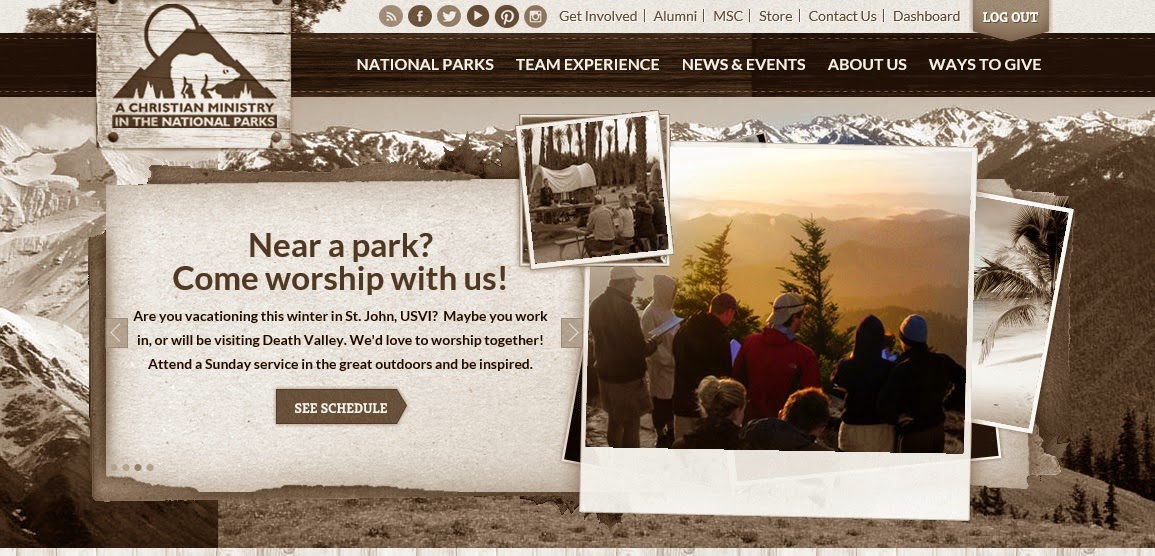
ACMNP (A Christian Ministry in the National Parks) has been around for a long time. It is the only opportunity that I know of which brings people from all different Christian backgrounds to worship together on government land. By focusing on Jesus and worshiping Him, the interdenominational ministry is able to bypass the denominational battles. It is a way to witness and worship in God's creation that cannot be done elsewhere.

This ministry is based in Denver, Colorado. But, it sends out teams of college students and seminarians through-out the country. In this way, the ministry is also able to form Christian leaders, both towards a vocation in church-work and apart from it. I love the fact that a biology, psychology, astro-physics, any-sort-of major can come and serve the Lord in this ministry for the summer.

As you can imagine both the struggle and the reward are great. The participants in this program are thrown into a life-changing crucible. They meet all sorts of people from all around the world. They have a variety of backgrounds, strengths, weaknesses, but they learn to work together as a team in each park. Their faith-life is challenged and strengthened. They may often feel alone, but they know they are held in Christ's presence.

http://www.acmnp.com/

 This journey of a lifetime begins with a training conference. The first one is next month in Denver, Colorado while a back-up conference (for the later applicants) will be in May in either Atlanta or Indianapolis. Then, the students finish their semester of school and head out to their park for the summer.

There is an additional Advanced Leadership Program which meets in Denver later this month. In the advanced program, seminarians are chosen (mainly alumni) who can undertake more responsibilities above and beyond leading worship on the weekends and evangelizing on the park grounds. They will be placed in parks that may not have had a team in the past or with other opportunities to build a more permanent outreach program within the park community.


I had the opportunity to serve in this ministry last summer at Glacier National Park in Montana and I have been accepted as a participant in the Advanced Leadership Program for this upcoming summer somewhere in northern California (the specifics are still being addressed). At the end of the summer, my spendings and earnings came out pretty even (if I would have stayed home, I would have been able to make a bonus towards tuition). Still, the privilege of serving in this ministry was priceless. And, only God knows what a difference we made in the lives who were able to worship at the park because of our ministry there.

The costs for the conferences are considerable as well as traveling to and from the parks. If you would like to assist me personally, contact The Raven. Otherwise, the ministry could really use your support (I think there are even ways to personalize your gift such as buying T-Shirts for certain teams or Bibles for a certain parks!!!). If you have any questions, I can get you in touch with the ministry's leadership, they're really great to work with and will probably be open to suggested gifts. If you know anyone who would be interested, make sure they apply.

More ways to assist:

  • Follow along on their blog.
  • Sign up for updates.
  • Pray.
http://www.acmnp.com/

***The ministry of the month encourages an annual donation of approximately $25 for its ministries (that seems the most reasonable way to help without hurting yourself too much). If there is a charity you are called to fall in love with and give the most to, that's a blessing. There is no obligation and this blog has no sort of compensation or really affiliation with the ministry that it is supporting (in general.. I am currently involved with this month's ministry).

*****Please, give me feedback on what you think of the charities/your experiences/charity suggestions... I'd extremely appreciate your input.

Romans 5 | Lent 2015

Here's the rough draft of the sermon today, it was clearer in presentation, but you should be able to get the gist from these notes:


Boast

1 That the Hearers Boast in His Love 

Gen. 17:1-7, 15-16 God’s fertile covenant… Abram becomes Abraham and Sarai Sarah.

Mark 8:27-38 Jesus asked his disciples “Who do people say that I am?” “John the Baptist… Elijah… one of the prophets.” “But who do you say that I am?” Peter answered, “You are the Christ.” 

He began to teach them that the Son of Man must suffer many things… killed and raised again after three days… he said this plainly. And Peter took him aside and began to rebuke him. But turning and seeing his disciples he rebuked Peter and said, ‘Get behind me, Satan! For you are not setting your mind on the things of God, but on the things of man.’ …

‘If anyone would come after me, let him deny himself and take up his cross and follow me. For whoever would save his life will lose it, but whoever loses his life for my sake and the gospel’s will save it.

For what does it profit a man to gain the whole world and forfeit his life? For what can a man give in return for his life? For whoever is ashamed of me and of my words in this adulterous and sinful generation, of him will the Son of Man also be ashamed when he comes in the glory of his Father…

Romans 5:1-11 Justified by faith, have peace with God through Jesus and access into his grace through faith… Here we stand. We boast/rejoice in the hope of the glory of God… even more we boast/rejoice in our sufferings knowing… suffering produces endurance, endurance character, character hope, and hope does not put us to shame.

Because God’s love has been poured out into our hearts through the Holy Spirit.

Even while we were weak, Christ died for the ungodly… For one will scarcely die for a righteous person, maybe for a good person but never an evil sinner… but God shows his love for us in that while we were still sinners, Christ died for us. We have now been justified by his blood… saved from the wrath of God… If while we were enemies we were reconciled to God by the death of his Son, much more, now that we are reconciled, shall we be saved by his life… we boast/rejoice in God through our Lord Jesus Christ through whom we have been reconciled.

(following, one man then sin for all)


2 Message


+ Grace, mercy, and peace to you from
God the Father and Jesus Christ,
His Son, our Lord. Amen.

All these words, hear them with your ears. But, hold them in your hearts.

“Lord, I need you.”[1] That is the beginning of our epistle today. Paul had begun his letter to Rome, the metropolis of the time, declaring that he is not ashamed of the gospel. He is obliged to share it to both Greek and barbarian; both the foolish and the wise; the Jew and the Gentile; white collar and blue collar; policeman and criminal; homeless and movie star. The fact is that “the righteous shall live by faith.”[2] But, he knows that we are not righteous. And, it is only by this faith that we can be made right again. We need Jesus Christ to be saved, he is “our one defense… our righteousness.”

But, Paul wasn’t always this way. Do you remember the first time he is mentioned in the Bible? It’s in the book of Acts, the second book the historian, Luke, wrote after the Gospel of Luke. After Pentecost and the Holy Spirit is spread into the hearts of thousands of people, one of those people who had been chosen to serve the Church stands alone. He was full of grace and power… doing great wonders and signs among the people… He spoke to the leaders of the synagogue and they could not withstand the wisdom and the Spirit with which he was speaking…

This bothered them. They did not know what to do, so they called him a heretic. They claimed that he spoke against the patriarchs of Israel and against God Himself. This was enough to seize him and bring him before the elder, the scribes, and all of the people. The brought in a council of fake witnesses. But, even as they spoke against him and slandered his name, as they turned to look at him they saw that his face was like the face of an angel.

The high priest asked him what he had to say for himself and the servant of the Church told the Israelites their own story. It was a story of a people whose ancestors had witnessed the glory of God. It was the story of a people who suffered. But, in this suffering, they were given the law. They turned the law into their god. They made a building for their Lord, but in the end worshipped the hands who had built the structure more than the hands who had formed them in their mother’s womb. They put God in a box rather than letting him live in their hearts. They circumcised their flesh, they did everything perfectly on the outside, but their insides were hardened. They had killed all of the prophets who had risen to help them. But, they couldn’t even complete the law they worshipped.

As you can imagine, this enraged all those who heard it. The elders, the scribes, the people around the Stephen ground their teeth. But, he did not look at them. He looked into heaven. He saw Jesus. He did not see Jesus sitting on the sidelines, but standing at the right hand of God. He was not a spectator but the only defense that Stephen had against his accusers. Jesus was his righteousness, the only one who made him right with God. You can almost picture Stephen saying, “My one defense, my righteousness, Lord, I need you.” But, his last thoughts were not of himself. They were of his accusers, the martyr cried, “Lord, do not hold this sin against them.”

I can almost see him looking up in one last glance, just out of the corner of his eye, to see the young man named Saul who was holding the garments for those who threw stones at the man who appeared to them as defenseless. God would later change Saul’s name to Paul. And, Paul would be charged with the task of reminding the Church that by faith in Jesus Christ we have peace with God (not let us have peace), we can rejoice in the hope of the glory of God.

Now, this phrase is a little hard to understand to us. When you think of “rejoice,” cheerful little smiley faces fill your head. A fake cheesy face makes a pose. Maybe someone even jumps for joy. But, the word here is the same as “boast.” Now, doesn’t that paint a different picture? “By faith in Jesus Christ, we can boast…” Now, instead of a pretend grin, a guttural shout rises to our lips. There is a pride, a confidence that arises within us. “We boast in the hope of the glory of God.”

This “glory of God” could also use some explaining, the “glory of God” is his presence. In all those scenes of Revelation, those who surround God are in his “glory.” On the mount of Transfiguration, the glory of the Lord is upon Jesus Christ. To be in His company is to stand in His glory. This is what we hope for. This is the hope that faith in Jesus Christ gives us. This is the hope we boast about.

We can even boast in our sufferings. That is what Stephen did. Although he was persecuted, he was proclaiming what God has done. He retained his faith and he saw Jesus standing in the glory of God, at His right side. He was also given the solid hope to stand there one day. This way-of-living, this worldview, effects everything else. We can even boast while we’re suffering. We know that this suffering is giving us the endurance we need to keep on boasting in our God. This endurance gives us the character we need to live in Him. This character clings onto the hope with which we had begun. Hope leads to hope.

This is why Saul became Paul, the faith in Jesus Christ which gave him the hope of the glory of God changed him. Jesus became his defense and his righteousness. This was the same in the Old Testament lesson, Abram was transformed into Abraham, Sarai to Sarah, not because of what they had done, not even because of the suffering they went through, but because of their hope in God’s promise. This hope does not put us to shame.

It would be easy to make this into a process of itself… to glorify suffering itself… to look for suffering in order to produce endurance… character… hope… But, the suffering is nothing apart from faith.

The opposite may also be thought of, does this mean that we do not need to suffer? Maybe we can skip that whole part of life after all. If we already have the character of hope built by faith isn’t that enough? That faith will be weak.

“Get behind me Satan.” Is what Jesus snarled at Peter. Peter had just claimed that Jesus was the Christ, the Son of God. But, then when Jesus started to explain that the Son of God must suffer, Peter rebukes him. More than anyone else, Peter reminds me of the second plant in the parable of the sower… he shoots up in faith, but then falls. But, here, for the first time in perhaps his whole career as a disciple of Jesus Christ, Peter actually understands what’s going on. Jesus spoke plainly about his death and Peter isn’t in for it. No one likes the fact that we were born into sin. Suffering is a part of this life. Jesus says that the life of a disciple is a life of persecution. It’s so much easier to avoid it. It’s easier to point blame or get rid of the problem. It’s simple to stomp down on others rather than reflecting on our own hearts. We are so weak… so sinful…

Although Jesus had never been the problem, he became the solution. He is our scapegoat. While we were still weak… still ungodly, Christ died for us. God showed his love in this. Instead of the wrath we deserve as His enemies, we have been given reconciliation. He suffered for us. Now, we boast in God through Jesus, our reconciler. If we try to save our own lives, we will lose them. If we find our answers in avoiding the situation, getting rid of the problem, stomping down on others… If we find our answers anywhere apart from the love of God which has been poured into our hearts through the Holy Spirit, our lives are lost. But, if we give our lives to live for Christ’s sake… for the gospel’s sake… we will be saved. We will be secured in our hope, we will live in the peace of God through Jesus Christ. Amen.


Now, may the peace that passes all our understanding guard our hearts and minds as we boast in the love of Christ Jesus, from this time forth. Amen.


[1] “Lord I Need You” Sermon Music Video


[2] Rm1…

Monday, February 16, 2015

The Beauty of Hozier's Church | Audio Review


If you like this song,
you might not want to watch/read this...


At first this song seems great, "take me to church." That's what our culture needs to hear. Although there is a natural need for worship, the singer lacks absolution. Although he has practiced a sort of love and communion, it ends.

The music video relays the story of idolaters. The two main characters are homosexuals who attempt to burry their secret. They fail. Their worship of sexuality is severely punished. The other characters who find the secret judge the others. They break into the main character's house, drag him out, and burn him alive with his secret. They worship legalism. They bow down to the Law.

The Law is a good thing. But, apart from Grace, (just like everything else) it is nothing.

Tullian calls this sort of legalism/idolatry cheep Law. The accusers believe that they are able to build utopia. They can create a culture free from sin. They just need to burn up their neighbors in order to do so. They're too blinded by the plank in their eye to see what their hands are doing. They don't have a view of deep Law, but only cheep Law. They don't realize that no one can complete the Law other than The One who has already done so. They don't realize that their sin is just as bad as their neighbors. All of these characters long to worship, but do not recognize the One to worship...

Our world cries out for Church. But, if in Church only the Law is found..... Then, that's not Church at all. (Need an example, check out what Jesus says to the Pharisees, the brood of vipers and white washed tombs...)

The Church is a place for sinners...
If you have to be perfect to be welcomed in,
the Church's doors would have all been closed a long, long, time ago.

Once, you understand the meaning of this song, its disturbing. But, it should be. The hard fact is that the world needs Church. But, the caring, loving, grace-filled, people have often become little more than an empty, hardened, condemning steeple.

Sunday, February 15, 2015

TASKMASTER | Super Inc.


"'The average high school kid today has the same level of anxiety as the average psychiatric patient in the early 1950s.' It turns out the problem wasn't limited to an age group. In 2007, The New York Times reported that three in ten American women confess to taking sleeping pills before bed most nights. The numbers are so high and unprecedented that some are calling it an epidemic....
 
This came across my screen about the same time that the news broke about the meteoric rise of Americans claiming no religious affiliation, shooting up from 7 percent in 1990 to 16 percent in 2010. When those under the age of thirty were polled, that percentage more than doubled again, to nearly 35 percent. While the numbers themselves were a bit of a shock, I wish I had been more surprised by the findings. From my vantage point as a pastor, I can tell you, it is truly heartbreaking out there.
 
The Good News of God's inexhaustible grace for an exhausted world has never been more urgent...
 
Anything else is an unquestioning embrace of performancism in all sectors of life. Performancism is the mindset that equates our identity and value directly to our performance and accomplishments. Performancism casts achievement not as something we do or don't do but as something we are or aren't... what people think of us are more than descriptive; they are synonymous with our worth...
 
It is high time for the church to honor its Founder by embracing sola gratia [by grace alone] anew, to reignite the beacon of hope for the hopeless and point all of us bedraggled performancists back to the freedom and the rest of the Cross..."
 
The Taskmaster (above) was thrown off by the need to perform his own works, create his own merit, build up his own version of himself. Because of his irreconcilable past, there would be no way for him to be a "good guy again." But, that's not where the story ends.
 
 
In some way, even this character had been used for good all along. Although he could never pay the world back for the damages he had done, he had merit and use to those who knew his value.

In another way, God gives us merit and use even in our weakness when we come to Him.

"The Gospel of Jesus Christ announces that because Jesus was strong for you, you're free to be weak. Because Jesus won for you, you're free to lose. Because Jesus was Someone, you're free to be no one. Because Jesus was extraordinary, you're free to be ordinary. Because Jesus succeeded for you, you're free to fail..."

Read more in "One Way Love" by Tullian Tchividjian.

Check out his streamed event next month.

Find out more about the Taskmaster's origin.